
Creating a successful website starts with a first critical step – a domain name. In this Guide, you will learn what exactly is a domain name and how to create a memorable one. We will explore some universal rules that makes a Domain Name good, so you can find an optimal choice for yourself. Lastly, we will answer some popular questions and doubts about the Domain Names in a short form of an FAQ section.
What is a Domain Name
Domain Name is basically a digital location for your website. You can think of it as home address, which is unique for every building. The address is composed of several factors, such as postal code, the street name, the city name. This concept also applies to Domain Names, but in a different shape.
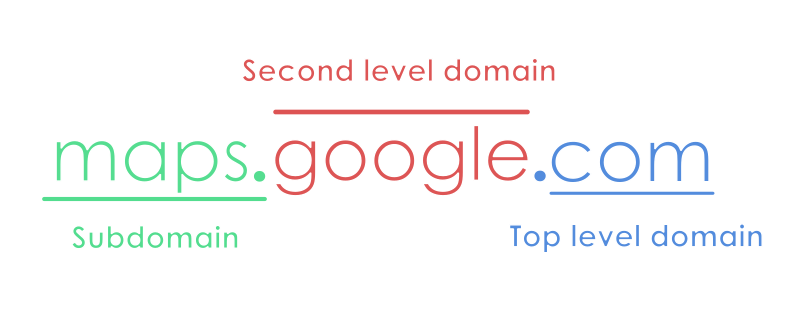
As you can see on the image above, a Domain Name may contain up to three components :
- Subdomain – optional one. It is used to segment parts of a website. When you register a certain Domain Name, you are then able to create subdomains. For example you can divide your blog portion of a website by using blog.mywebsite.com. Alternatively, to separate an online store, you can go with shop.mywebsite.com.
- Second Level Domain (SLD) – this is the name of your website. The most customizable part of a Domain Name. You are free to come up with any name that you want – as long as it’s not already taken. The popular examples of SLD are “google”, “facebook” or “wikipedia”.
- Top Level Domain (TLD) – also known as “domain extension”. It is the final part of a Domain Name. TLD initial tells about the website theme, purpose or the owner. The popular examples are “.com” or “.net”.
In this Guide, we will focus mostly on Secondary Domain Name. If you also want to learn more about Domain Extensions, please check our detailed guide for choosing domain extension.
How to create perfect Domain Name
Below are the general rules you should follow to make the best choice for your Domain Name. By following guidelines below, you can be rest assured that your Domain Name is memorable,
1. Keep it short
The key factor of a good Domain Name is length. The shorter it is, the better. Shorter Domain Names are more memorable and there is less room for typos or spelling errors from your visitors.
The optimal range for a Domain Name is no more than 14 characters. Names within this range are memorable and have high branding potential. Unfortunately, as Domain Name market is over 40 years now, most of concise Domain Names are already taken. This is true especially for popular domain extensions, such as “.com”. In cases where your dream Domain Name is not available, you can try to check it again with different domain extension.
2. Avoid numbers and hyphens
While digits are possible for Secondary Domain Name, you should not use them. Numbers are easy to get them wrong. Let’s imagine you are an owner of a website named “90degrees.com”. If you try to tell people the name of your site, be prepared some will confuse it with “ninetydegrees.com”. That is a quick way to send your potential visitors to competition. You just don’t want it to happen.
Also, do not use numbers to shorten your domain name. Websites that use numbers to replace certain words or letters are confusing and less trustworthy. Think of “songs4kids.com” or “flow3rmaz3.com” They are not an excuse even as a replacement when desired Domain Name is taken. It is generally harder in terms of branding, and you can run into legal problems if your Domain Name tries to mimic other, already trademarked brand.
Hyphens are even worse than numbers. Domain Names tend to have a single word structure. It is very uncommon to see websites using hyphens in their names. People unconsciously treat “hyphenized” names as more scammy, especially for longer Domain Names. On top of that, they make the Domain Name longer. There is no real benefit of using them.
If your desired Domain Name is taken, using hyphens between composing parts is still a bad idea. Most of the times, you should be fine with slightly altered Domain Name. Just remember to not poison it with digits and hyphens – at all cost.
3. Make sure it’s easy to spell and type
Your Domain Name should have a simple and predictable structure. You do not want your users to type your domain name incorrectly. They can end up on completely different website, which often means losing your visitors for once and for all. To prevent such scenario, your Domain Name should not leave people uncertain how it is written. Just follow these few rules:
- Opt for short Domain Name – as we mentioned before, aim for a name no longer than 14 characters.
- Avoid words with complex spelling – words like “conscientious” might not be a good fit for a Domain Name
- Avoid unconventional spelling – do not create abbreviations (using “u” instead of “you”; using “b” instead of “be”)
- Avoid same consecutive letters – especially if they are a part of different words, like: “gardennorth”. That being said, do not go for tripple letter, as you could with “coffeeexpert”
4. Make it brandable
When it comes to creating your Domain Name, there are two observable naming patterns. You can either go with a keyword-rich or branded domain name. We will illustrate the differences in below example.
Let’s imagine you are an owner of a blog related to cooking. You may come up with a domain name like “bestrecipiesblog.com”. It is an example of keyword-rich domain . The domain name is built upon several keywords (best, recipies, blog). With such name, people looking for “recipies blog” or “best recipies” were very likely to stumble upon your website. The keyword strategy used to work some years ago. Nowadays, as Google Search Engine has changed, spamming keywords is not as impactful as it used to be.
As an alternative, and currently the best pattern is to go for branded domain name . Following the cooking blog example – a branded one might be “dancooking.com”. It still contains a keyword – “cooking”, but there are some extra benefits:
- Credibility – branded domain sound more professional and trustworthy compared to keyword domain names.
- Scalability – scaling towards different services are much easier and smoother with branded domains. They are less generic, hence more flexible.
- Brand Awareness – branded domain names are more abstract and original. If you own a business with physical location (like a shop or restaurant), your website name should match your business name. For example, with a company name “Luigi Pizza”, having a website named “thebestpizza.com” will not resonate well.
5. Choose correct domain extension
Domain extension (Top Level Domain) is the ending part of a Domain Name. It is underrated, but crucial for how users perceive your website. Correct extension can boost credibility and give more trust. Wrong one can do otherwise. Some examples of Top Level Domains are: .com, .net, .ai or .shop.
The question remains – which extension to choose? We wrote in-depth about domain extensions in this guide. For a quick reference, here is a short overview of few possible extensions that you can use for your Domain Name:
- .com is the safest and most reliable general purpose extension, however not much available nowadays. If you struggle to find a good Domain Name with .com, you may try some other alternatives, like .net or .org .
- If your business is serving customers from specific country, then country code extensions might be a good choice. Some examples are: .de (for Germany), .es (for Spain) or .fr (for France).
- If you want to clearly communicate the theme of your business, you can go with industry-specific extensions, such as: .fashion , .tech or .dance . They are descriptive and available, but some can raise trust concerns as these extensions are not seen very often.
6. Think of scalability
Domain Name can say a lot about your website. It can describe the purpose of your business or the services you offer. Users will expect that website named “shoemaker.com” is a place to buy shoes. But what if one day the owner decides to extend his business to also sell jackets? This we can reach a situation, where a Domain Name becomes your worst enemy.
It does not to have to be this way though. Instead of “shoemaker.com”, going for “clothmaker.com” might be a better fit if you ever plan to extend your offer to more types of clothing. That way, your business is more cohesive and you will not run into a problem we mentioned. Think long-term and be prepared for future expansion.
Remember that there is nothing bad in staying within your niche. Just make sure to be consistent with your future vision. Try to tackle the question: “How would my business look like in 10 years?” – and keep your Domain Name in accordance with your answer.
7. Research your Domain Name
Once you come up with your Domain Name, it’s time to check if that name is not already taken. Someone might have taken it before you. In this case you can either try with different domain extension, or you can slightly change your Domain Name (remember to not use numbers and hyphens). before registering your Domain Name, verify if it’s not already taken. This applies especially for trademarks
Depending on which way would you like to expand your business, there are some extra steps you should take before purchasing that dream Domain Name. First, try to research your potential competitors. Type your Domain Name with the extension in the Google search bar and check for results on the first page.
Are Domain Names of result websites feel overly similiar? Or maybe there is one with the same Domain Name, but different extension? If an answer to any of the questions is “yes”, that signals a potential competition.
In case you want to expand your presence to social media, you need to check your name’s availability. It is very important that your website name is closely related to usernames you will use for your social media accounts.
For example, if you decide to go with “cookingdreams.com”, ideally your username on social media should be also “CookingDreams”. However it’s very likely there was a person before you that took such username long time ago. If that’s the case, aim for extra prefix or suffix to this name – “TheCookingDreams” or “CookingDreamsOfficial” are great examples.
Luckily, you do not have to check every social media site manually. There are some free, dedicated tools (such as Knowem), that allow you to perform a quick search for major social media websites in one go.
Lastly – avoid names that are registered trademarks . Otherwise, you may run onto serious legal issues – we don’t want that to happen. That is why we recommend you to run a search on websites like: Justia Trademarks or UPSTO (for United States trademarks).
Frequently asked questions
In the last section of this Guide, we will answer some popular questions or problems. They may arise during the process of choosing or purchasing the Domain Name. If you have any other questions regarding this topic, please let us know in the comment section below. We may include them in the FAQ list later.
What if my desired Domain Name is taken?
In such situation, you can try to modify your Domain Name by using synonyms. Do not use number or hyphens for that purpose – it creates confusion among users. For those willing to keep their dream Domain Name unchanged, it’s still possible to change the domain extension (eg. from “.com” to “.net”).
Should I buy multiple TLDs for my Domain Name?
It highly depends on your prior popularity online. If you are well-known on social media and already have a decent fanbase, it is a wise strategy. Buying the most popular TLDs (.com, .net, .org) for your website can prevent other people to try impersonate you. However, if you are just starting out your business, going with one domain extension is just fine. As you grow and become more recognized, you should secure other popular extensions to eliminate potential competition.
Can I permanently buy a Domain Name?
No, it’s not possible. You can think of it as a subscription-based model, but with yearly fee. Some Domain Registrars allow to prepay respective amount for several years, which might be a convenient option. Nevertheless,