

The domain extension market has evolved through over 40 years of its history. Back then, with not many possible options, people mostly chose the .com domain. However, over time the clear line started to blur. As of 2025, with over 1600 available options, it is increasingly more difficult to make the optimal pick. Each extension has its own meaning, and poorly chosen one can confuse users or even make your website feel as scammy or less trustworthy.
In this guide, I will walk you through the domain extension market, explaining which extensions in particular might fit well for your type of website. We are going to uncover the use cases of all available types of extensions, as well as assessing their strengths and weaknesses. You will also learn what are the main factors you should consider when looking for a perfect option.
What is a domain extension
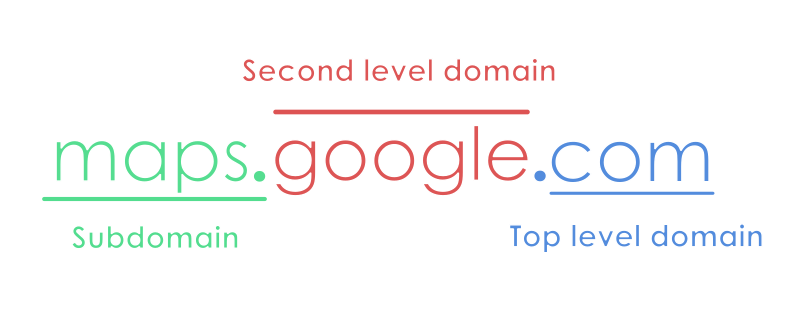
A domain extension (also known as Top Level Domain – TLD), is the final part of Domain Name, which always goes after the very last dot. For example, our website is using a .com TLD, but there are many more like .net , .shop , or even .wtf – we will talk about all of them a bit later.
For now, let’s briefly mention the other two components of a Domain Name. One of them is a Second Level Domain (SLD) – this is simply a website or brand name (“prowebguides” in our example). It is preceding the domain extension. The last piece of Domain Name is “Subdomain” (also referred as Third Level Domain) – it is used to segment a portion of your website. Think of “maps” in maps.google.com or “support” in support.microsoft.com). A subdomain is purely optional – you may not see it on the majority of websites – including ProWebGuides.
Below is a simple visualisation of Domain Name example, split into its components:
A common misconception for Top Level Domains is that search engines treat extensions differently SEO-wise. Here is what we can read on dotroll website:
Google has publicly stated that TLDs are not a direct ranking factor, meaning the type of domain itself does not automatically cause a site to rank higher or lower. However, the TLD you choose can influence several indirect signals that affect SEO.
As you can see – Google search algorithms treat every TLD equally, but users do not. Their attitude towards your website is very important. A correctly chosen TLD might positively impact your website perception, increasing their engagement with your website and boosting click-through rates (CTR), which in turn positively impacts website SEO.
What aspects to consider
When looking for domain extension for your website, there are several factors you should consider. Below I will shortly describe the general metrics that define value of particular TLD:
- Availability – how popular is the extension? Are there still many available Domain Names with that TLD ?
- Trust – how an extension is generally perceived by users? Is it perceived as trustworthy or rather scammy ?
- Branding – does the extension have good potential when it comes to branding ?
- Memorability – how recognizable an extension is? Is it well-known and easy to remember ?
- Restrictions – are there any limitations on who can register the domain name with a given TLD ?
- Price – what is the yearly rate for a TLD? Is there any price difference for the first year and for following years ?
Note: In terms of pricing, we refer to 2025 rates for domain extensions from Namecheap registrar. The prices may slightly differ across different registry platforms. Also, estimated values are for extensions under standard domains. Premium domains tend to be much more expensive – usually over $2000, and those are not included in our research.
Types of domain extensions
During the early days of the Internet, people had not much options when it came to choosing a Top level domain. The legacy list of possible domains contained as little as seven entries, and yet three of them were already restricted to be used for authorities only – leaving regular companies and individuals with as little as four initial TLDs.
Nowadays, looking for the best domain extension might be a challenging task. The number of increasing possibilities might be overwhelming. That is why for more transparency, there are several TLD groups , which help categorizing extensions by their characteristics. Each of these groups are fundamentally different, and included TLDs serve distinct use cases.
Let’s see all relevant TLD groups, from which you can choose the best domain extension for your website:
- Generic TLDs
- Country code TLDs
- Geographic TLDs
- Industry-based TLDs
- Generic Restricted TLDs
- Sponsored TLDs
- New TLDs
A quick note: This guide deliberately does not cover Infrastructure (ARPA) and Test domain groups. Both serve special purposes and it is not possible to register a domain name with extensions belonging to any of the two groups. They are outside of the scope of this Guide.
Generic TLDs
The holy trinity of TLDs – .com, .net, .org. Despite over 40 years of their existence, they remain as the most popular domain extensions. The main strength of this group is memorability – many web users are very familiar with the three TLD’s. They are used by many different entities – businesses, startups, individuals and professionals. They are liberal in use as well. No formal restrictions for what type of content it can or cannot be used. Use them for anything you want and your website will be just fine.
The global usage of .com, .net, .org is so significant, that they “power” more than half of websites online. According to 2025 research from Hostadvice.com, these three TLDs combined are used by over 180 million websites :
Of the over 350 million domains registered, more than 158.7 million are .com domains, 12.9 million domains are .net, and 10.7 million domains are .org. These three TLDs represent a little over 52% of all registered domains.
As part of the Generic TLD group, some companies have registered their own extensions. For example in June 2015, Microsoft registered a TLD named .microsoft , and since then the company is allowed to exclusively use this extension for company websites. There are more TLDs that follow the pattern – .nissan, .lidl, .samsung, just to name a few. All established by their respective companies. Such extensions are restricted, and regular registrants cannot use them.
Now let’s focus back on unrestricted extensions. Below is a full breakdown of .com, .net and .org extensions one-by-one, so you can better understand their differences and main benefits:
.com
A general purpose TLD, that can fit basically any type of website. It was designed to distinguish entities with commercial intent – such as businesses and startups. However, the real use case is much wider. Bloggers, artists, retailers often choose .com for their website extension. It also belongs to the few oldest extensions to exist. In fact, the earliest .com registration was Symbolics.com, which happened on 15th March 1985, being historically the second oldest Domain Name.
Recommended for:
ℹ️ Websites of any theme and purpose. The best fit however would be commercial websites.
PROS:
✅ Memorable – for many web users it feels like a “default” extension. When people do remember your website name, but not the extension, their first guess will likely be .com
✅ Trustworthy – popular TLD used by major, well-known brands like Google or Facebook. It makes your site look professional and gives extra credibility.
✅ Low price – ranging from $15 to $20 in most cases, it is very affordable extension, and relatively cheap for such popular choice
✅ Unrestricted – there is no formal restrictions that needs to be met in order to use .com extension – and there never were.
CONS:
❌ Generic – The extension alone does not say much about your website, its theme or purpose. You can make up for it with appropriate Secondary Domain Name.
❌ Availability – over 150 million .com domains are already taken. Looking for a short and memorable Domain Name with .com is a challenging and very time consuming process.
.net
This TLD comes from the word “networking”. It was meant to be used by Internet Service Providers and networking companies. Similar to the .com situation, the extension is now used by many different types of websites, even outside tech. Although .net still appeals to the tech-savvy businesses, it has become a popular replacement for .com. When your dream .com Domain Name is taken, there is a decent chance that .net version is still available.
Recommended for:
ℹ️ Websites of any theme and purpose. Bonus points if the website is tech or network oriented.
PROS:
✅ Memorable – combined with a concise domain name, you can achieve a very satisfying and memorable result. A tech-themed websites might benefit from .net even more
✅ Trustworthy – used by millions of websites, it is still very recognizable extension which brings users trust (although not that much as of .com or .org)
✅ Low price – very affordable, the purchase price is at around $10 – $18
✅ Unrestricted – anyone can register a .net domain without any hassle.
CONS:
❌ Availability – around 13 million domain names are already registered. A lot less than in case of .com, but that is still a significant amount.
.org
The extension was created to keep place for those websites that did not fit to other early TLDs. The .org is an abbreviation of a word “organisation”, and used to be a viable option for not-money-driven entities, like NGOs and political parties. As with .com and .net, the extension’s intended use has changed. While still appreciated by charities and other non-government organisations, this TLD is often used for websites with commercial purposes. Following that, .org is yet another popular alternative in cases where .com domain name is taken.
Recommended for:
ℹ️ Non-profit entities
ℹ️ Non government organisations (NGO)
ℹ️ Charities and other not money-driven websites
PROS:
✅ Memorable – an extension that is easy to remember and recognize
✅ Highly Trustworthy – since .org is widely associated with non-profit activity, it gives the highest level of trust among other unrestricted TLDs.
✅ Low price – .org is slightly cheaper than .com or .net, ranging from $10 – $15
✅ Unrestricted – any website can be registered with this extension, there are no limitations
CONS:
❌ Availability – over 11 million domain names in use. Still it can be a good replacement if both .com and .net are taken.
❌ Non-profit usage associations – despite the fact an .org website can be used also by for-profit entities, users usually expect otherwise. For some, encountering a .org site with commercial or business intent, may feel strange or suspicious.
Country code TLDs
With the steady evolution of the domains market, came a question – how to make it easier for websites to target local audiences? That’s a part of a reason for country code TLDs to emerge. A consequent introduction of new country extensions started from .us (for United States) back in 1985.
These country specific TLDs present a great opportunity to connect with users from a specific location. A concise, two-letter extension is a representation of a country code in ISO-3166 format , that is based on native name of the country. Domains that utilize this type of TLD are more likely to appear in top search results for their specific region. For example, a .fr extension might make your website more exposed to French users. Furthermore, it gives your website a unique identity and brings more trust towards your site from the local community.
As an extra note, there are also TLDs that refer to territories instead of sole countries, like .eu (European Union) or .io (British Indian Ocean Territory). The amount of this type of extensions combined with country-specific ones, gives a huge amount of possibilities – as we can read in Fasthost post from 2023:
There are 308ccTLD’s, which shows just how many countries, regions and languages are jumping on the bandwagon of owning a ccTLD. Regions that are separated from their mainland country can also receive their own ccTLD, too.
Let’s see what are the main pros and cons of country specific domain extensions:
Recommended for:
ℹ️ Businesses with customer base from particular country
ℹ️ Websites of any kind, available in language that is spoken in target country
PROS:
✅ Often available – domain names for most country extensions should be pretty available. It may depend on the country though, as for China – for example – it is over 36 million domain names taken!
✅ Memorable – very easy to memorize as they are always two letter length. They refer to country native names and are the same as suffixes for e-mail addresses
✅ Trustworthy – these extensions are generally trusted among the citizens of targeted country. The situation may vary for users outside of it.
✅ Low price – in most cases, country code TLDs pricing is under $10. There are few exceptions of more expensive ones as they are gaining traction (for example .ai – the price is currently at around $80)
✅ Mostly unrestricted – most country code extensions can be registered with no restrictions. However there are few restricted ones – like .fr for France, where the registrant has to be a resident of the European Union.
CONS:
❌ Single country focus – domain extension might suggest it is intended only for users that belong to the country or region expressed in TLD. It may significantly reduce the amount of visitors from other countries.
On a creative side – some companies realized that certain country extensions might be a better choice for branding purposes. A well-known example is Twitch.tv – an American video live-streaming service. This “tv” extension is not meant to mean “television”, as many may have thought. It is actually a country code for Tuvalu. This common misunderstanding actually benefits Twitch, as a platform is about watching videos in real-time – almost as is in television. Pretty smart, right?
Here you can find a list of extensions that are used in the same fashion as said above. It is not a complete list though. If you know more interesting uses for country-code domains, please let the world know in the comments section below!
- .co – TLD for Colombia country. It used to be restricted only for entities that operate in Colombia. Now anyone can use it. Hence, some websites use it as a replacement for .com, when it is not available. Also abused by malicious actors (as .co is a potential typo for .com)
- .tv – originally a TLD for Tuvalu country. However, it is more often used as an abbreviation for “television”. Example: Twitch.tv
- .ai – TLD made for Anguilla (a British Overseas Territory in the Caribbean). Casually used by businesses that specialize in Artificial Intelligence (AI) services or software.
- .io – an extension made for British Indian Ocean Territory. It is associated with a term I/O (Input/Output) in computer science – and tech companies simply loved it.
- .fm – TLD created for Federated States of Micronesia. Occasionally used by audio broadcasting websites or online radio stations. The “fm” abbreviation might also mean “frequency modulation”, which is the term related to radio. A good example could be Last.fm radio website.
- .me – a domain extension designed for Montenegro country. It is also used for personal websites or portfolios, as this abbreviation fits such perfectly.
- .cv – Cape Verde’s TLD that is also used for… resume websites.
- .gg – TLD originally intended to represent Guernsey territory, although it got more recognition in the gaming industry. Many gaming-related websites use this extension.
Geographic TLDs
Aside from country-based extensions, there is a similar TLDs group, although a little less generic. This one actually targets geographical places – mainly cities and continents, but also names of geographic origin. Some of the examples include: .london, .sydney, .nyc (New York City), .africa or .irish .
These geographic domain extensions might seem overly specific to effectively target an international audience. They might be perceived as less relevant than country code TLDs. However, their real power remains in an aspect of locality. A website which aims to show libraries in London, will actually benefit more from .london extension rather than country code .uk – which might mislead users in such a scenario. Websites that promote cultural aspects of its region can be also a good candidate for geographic TLD.
Unlike country extensions, many geographic TLDs are restricted. For example, in order to use the .paris extension, the registrant has to be a resident, company or organization based in Paris. Such requirements strictly limit who can get such geographic TLD, which also adds an extra layer of trust towards a website. The restrictions for geographic extensions might be different from one another.
They are some other factors that you need to consider before choosing this type of domain extension. First of all, geographical TLDs truly shine when your website is targeting a local community or when it covers a very specific, narrow topic of interest. They are not a good fit for business purposes – even when your business is local, country code domain extensions or more generic ones (like .com or .net) are usually better options. On top of that, these TLDs are not budget friendly – most of them cost at least $35, being around three times more expensive than most country code TLDs.
Recommended for:
ℹ️ Websites promoting target region
ℹ️ Local culture websites
ℹ️ Community-driven sites
PROS:
✅ Available – they are not a very popular choice, which is a good factor for availability.
✅ Memorable – despite some geographic TLDs being lengthy, they mostly refer to well-known city names or regions.
✅ Trustworthy – they present high trust value, as most are being restricted, and they meant to target smaller audience.
CONS:
❌ Expensive – Most geographical domains are above the average in terms of TLD price, usually starting at $35. The exception here is .africa, which price is around $13.
❌ Mostly restricted – Geographical TLDs may put some restrications on who can register the TLD. It is most of the time related to the residence of the registrant.
❌ Single region focus – the extension itself might trick some users to think a website with such TLD is created only for audience from that region.
Industry-based TLDs
Over years, the amount of online businesses were growing, while the amount of available TLDs was getting lower and lower. To address that situation, a new category of domain extensions started to emerge. Those are industry-based TLDs .
They serve as a reasonable option especially in cases of commercial websites. By just reading the extension name, users can already tell what your website will be about. Think of extensions like: .tech, .fashion, or .beauty – they are all examples of industry-specific domains. For people looking for a TLD related to e-commerce, there are also two well adopted ones: .shop and .store .
Industry-based extensions not only are much less generic than .com , .net and .org , but more available. On top of that their branding potential is unmatched, giving a lot of creative naming opportunities, that are otherwise impossible with generic domain extensions. A good combination of Secondary Level Domain and Top level Domain can lead to a very memorable and brandable domain name – which are more than welcome in fields related to e-commerce.
Keep in mind, that while industry-related extensions can benefit your website, it can also cause harm if used improperly. The major concern is trust factor. Many web users are not very used with these type of TLDs. In more conservative fields, where trust is extremely important, such extendsions like .finance or .health might cause a skepticism among potential users, who might eventually avoid visiting your website. It does not mean such extensions are bad upfront, but they may involve certain risks. As we can read in NameSilo blog post:
Industry TLDs are gaining ground but unevenly. Sectors like fashion, tech, and entertainment embrace them quickly. More traditional fields like law, finance, and healthcare move cautiously. In 2025, we see a split: innovative brands use industry TLDs to stand out, while conservative ones stick to .com to avoid risk.
Let’s examine a more detailed list of pros and cons when using industry-based domain extensions for a website.
Recommended for:
ℹ️ Websites or blogs specializing in a target field
ℹ️ Online shops and stores
ℹ️ Experts offering paid services online
PROS:
✅ Descriptive – these extensions are already telling what users may expect from the website, which may increase click-through rate.
✅ Highly brandable – mixing a catchy Secondary Level Domain with industry-specific TLD works very well altogether.
✅ Available – there is not much of a competition comparing to more generic TLD’s. You should be able to compose a good Domain Name without issues.
✅ Unrestricted – any website can be registered under industry-based TLD
CONS:
❌ Expensive – indsutry-focused extensions are newer, and they are generally more expensive than older, well-established alternatives. Usually, prices start at $30. Even if you encounter a cheaper registration price, after 1 year of using such an extension, the renewal cost becomes much higher.
❌ Trust concerns – some particular TLD’s might feel less trustworthy compared to their generic alternatives (for example – for some users, a financial consulting site with .com might bring more trust than .finance);
Below is a concise list of industry-related domain extensions, which in our opinion are safe to use and should not cause trust-relevant issues. Please note it is just a subjective take, do not take every entry here for granted. We recommend doing your own research about particular TLD before buying a Domain Name with it.
- .shop
- .tech
- .fashion
- .bakery
- .beauty
- .academy
- .dance
- .club
Haven’t found any industry-specific domains that fit your theme? No worries – these were just examples. For a full list of all available TLDs, please check an official ICANN list .
Generic Restricted TLD’s
What might come as a surprise is that not every domain extension can be freely used. Some of them require you to satisfy specific conditions in order to maintain such TLD. This was historically the case for .name, .biz, and .pro extensions. Each of them were possible to initially register, but in order to maintain them, the owner had to officially prove their website is operated by proper entity:
- For .biz – a business (company)
- For .name – an individual
- For .pro – a licensed and credentialed professional
Those days are long gone. Nowadays, the restrictions have been cancelled, making those extensions much more accessible. However, it is still highly recommended that you choose the domain according to their use-case. For example, using .biz for a personal website might confuse users. In this situation, a .name extension might be a better option. In case you are a freelancer offering services to your target audience, a .pro TLD will be your go-to.
Formerly restricted extensions are much more available as they are not used very often. The mentioned group still has a satisfying amount of possibilities for a perfect domain name. Apart from that, the extensions put a strong emphasis on who owns the website and can give users an initial hint about its purpose. At the same time .biz and .pro sound formal and competent, while .name could be still a valid choice for non-commercial websites with a bit of personal touch.
On the other hand, there are few challenges that you may come across when using one of those extensions. The first being lower recognition. These TLDs are not so well adopted, which makes them harder to recall and may require more effort in terms of branding. There are also trust concerns that may arise, especially that these TLDs are not among the popular ones.
Recommended for:
ℹ️ .biz – for businesses of any kind;
ℹ️ .name – for personal websites;
ℹ️ .pro – for professionals;
PROS:
✅ Available – especially .name and .pro; .biz is sometimes used as a replacement for .com, but not in a huge scale
✅ Reasonable price – regular domain names with .pro and .biz are at around $20 – $25; however .name is very budget friendly – below $10 / year.
✅ Currently unrestricted – used to be a group of restricted extensions; nowadays they are not officially regulated.
CONS:
❌ Trust concerns – despite their professional sound, these TLDs for some people may feel less trustworthy and websites that uses them can be treated with more caution. They might be sometimes perceived as scammy.
❌ Harder to recall – because of low popularity (.pro, .name) or better-established competitors (.com over .biz), such TLDs like are not yet intuitive. If a user forgot what domain extension your website uses, it will be harder for them to recall.
Sponsored TLDs
This group of domain extensions is the least accessible one. Each of these TLDs belong to its organization, that is sponsoring and managing their TLD. As a result, such entities are allowed to enforce their own strict rules for owned TLDs. It means some upfront requirements to be met in order to be able to use that extension – oftentimes belonging to a specific industry. In this manner a Top Level Domain can effectively serve its intended audience and nobody else.
To better illustrate the above definition – one of sponsored TLDs is .aero . The company sponsoring this extension is named SITA, and in order to use their .aero TLD, one has to belong to the air-transport industry. There is also a .post extension – sponsored by Universal Postal Union. The organisation only allows postal services to use their TLD.
At the time of writing this Guide, there are exactly nine Sponsored domain extensions. Three of them are directly tied to United States of America, also being the oldest sponsored domains:
- .gov – can be used by US government and local governments
- .mil – US Military entities are allowed to utilize this TLD
- .edu – only institutes of higher education from US can register
From the different nature of sponsored TLDs, comes unique benefits. Since they are extensions of closed access, they guarantee the level of trust that cannot be achieved by any other TLD group. Another aspect is wide availability of Second Level Domains. Sponsored extensions are maintained in a controlled environment. They serve a very narrow group of websites – and availability is not going to be a problem at all.
Websites that use sponsored domain extensions are not meant to gain any commercial success, but rather be a reliable and authoritative entity in the field they represent. That is why such TLDs are not used for branding purposes. Their pricing is solely up to the sponsoring organisation, and might be very expensive in cases where sponsor has not established a sustainable pricing strategy to maintain their TLD.
Recommended for:
ℹ️ For theme-specific, closed communities;
ℹ️ High authority entities – government, educational institutes, military;
PROS:
✅ Available – there is little to no competition in sponsored TLDs sector
✅ Highly trustworthy – users of particular TLD have met certain (oftentimes very strict) requirements, which technically eliminates occurrences of scammy and malicious websites
CONS:
❌ Highly restricted – sponsored TLDs are owned by independent organisations, that are in power to set their own rules of access and usage.
❌ Low branding – these extensions are not made for commercial purposes, but rather to unite entities operating on the same field.
❌ Unreliable pricing – pricing is implicit and regulated by the owner organisation.
New TLDs
The last group of domain extensions is named “New TLDs”. It is a place for extensions that do not fit into any of the above categories. A largest TLDs group out there, which also means a lot of variety when choosing a domain extension. These extensions are also not popular ones, so the availability for Domain Names should not be a concern. The pricing is generally average, although very individual. The scope is usually from $5 to $20, with notable exceptions: .online cost below $3 yearly, while .protection can cost a staggering $2000 for one year.
The supported TLDs are very different from each other – there is no observable pattern. You may find some reasonable options like .studio or .info. Although, there are many more weird and rather unconventional options, such as .wtf, .fail, .sucks. You need to review new TLDs carefully, as this group is purely hit or miss. A wrongly chosen extension may cause more harm than good.
Here are some other examples of extensions that belong to “New TLDs” group :
- .top
- .sex
- .click
- .promo
- .love
- .xyz
A group of New TLDs falls apart when it comes to delivering trust. Their usage is very little, and they do not sound professional. Web users can often associate them with scam; that belief can seriously impact authenticity and branding potential. Furthermore, they can be confused with other, more popular TLDs.
Recommended for:
ℹ️ Experimental websites
PROS:
✅ Highly available – wide variety of available naming options for those TLDs
✅ Usually low price – usually below $20, with some extremely cheap options (even below $5). These TLDs rarely go beyond $30, but there are individual cases when the price is above $100.
✅ Unrestricted – no limitations, anyone can register an extension from this group.
CONS:
❌ Low trust – extensions that are mostly unknown are perceived as scammy. A TLDs group commonly abused by malicious actors.
❌ Low branding – unpopular TLDs with rather bad reputation might negatively impact branding potential
❌ Not memorable – most of domain extensions from this group are not very intuitive to users, which generally make such TLDs easy to forget.
Final thoughts
The domain extensions market is constantly growing, providing more and more possibilities to express your brand online. On one hand, we have good old TLDs like .com, .net and .org, which are very safe. well-established and still popular options. On the other hand, modern alternatives like .shop, .ai or .tech have emerged, delivering a more individual and descriptive value for your Domain Name. There are also country-code and geographic extensions, which are a great opportunity to connect with local audiences. And lastly, for those who want to express themselves in a more professional way – .biz, .pro and .name are all reliable options to achieve that goal.
Keep in mind that domain extension is something more than just a fancy ending to your website. It is a way to communicate with your audience and a building block for your online presence. When you choose an extension wisely, users will understand the intent of your website even without viewing it. Combined with a fitting Secondary Domain Name, they will associate your website with professionalism and credibility. But every successful journey has to start somewhere, and choosing a perfect TLD for your website might be the first step for it.